PM Skills in 2026: From Product Manager to Product Builder
2026 updated

Most people think top Product Managers get paid more because they are better at frameworks.
That is not what I’m seeing.
The highest-value PMs are usually great at one thing. Creating clarity when the business is uncertain. AI is making execution faster. Which means judgment becomes more valuable.
If AI can help write documents, summarize research, and generate ideas faster, then the differentiator becomes:
- What should we do?
- Why does it matter?
- What tradeoff are we making?
- What problem are we actually solving?
That is strategic judgment.
The PMs who grow the fastest over the next few years will probably not be the people who know the most tools. They will be the people who make the best decisions. That is a much harder skill to automate.
PM Skills in 2026: What Product Managers Need Today and in the Future
The role of the product manager is changing.
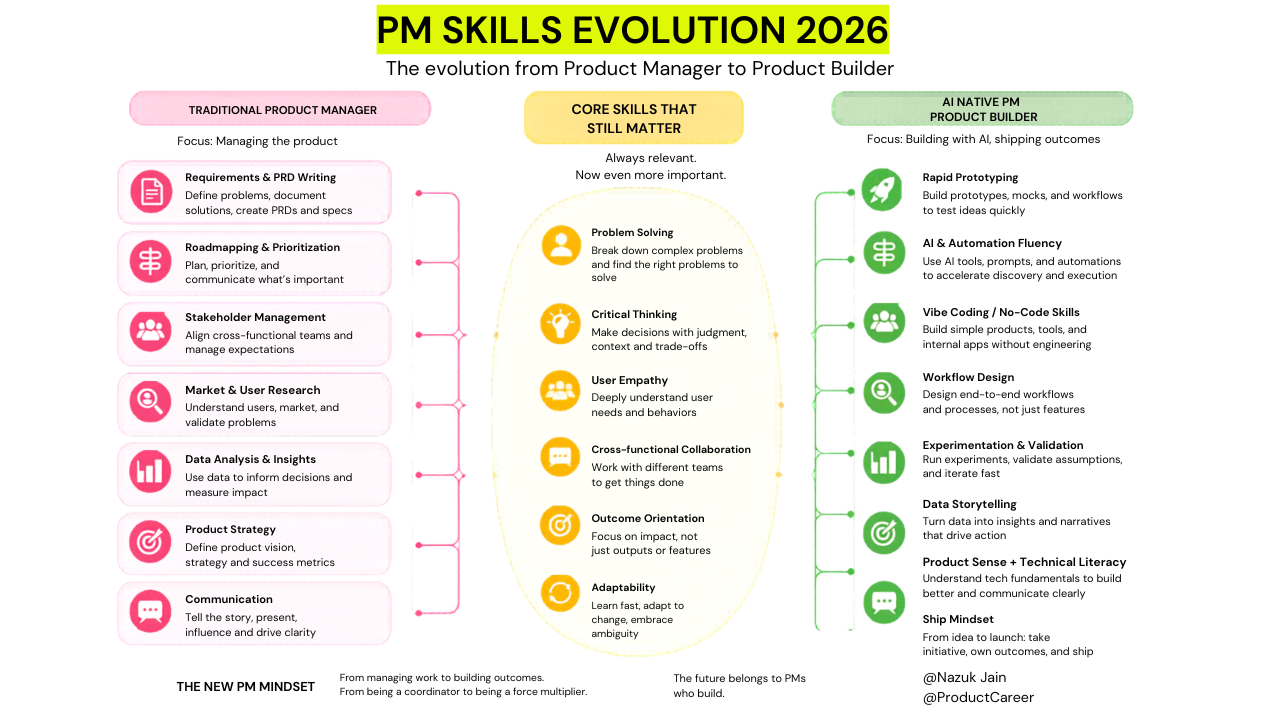
For years, PMs were primarily valued for managing the product: writing requirements, aligning stakeholders, prioritizing roadmaps, and communicating across teams.
Those skills still matter.
But in 2026, they are no longer enough on their own.
The modern product manager is evolving into something more powerful: a Product Builder.
A Product Builder does not just manage ideas. They make ideas tangible. They use AI tools, prototypes, workflows, data, and product judgment to move faster from problem to outcome.
This does not mean every PM needs to become an engineer. It means PMs need to become more fluent in how products are built, tested, automated, validated, and shipped.
What are the most important PM skills in 2026?
The most important PM skills in 2026 are a combination of classic product skills, durable thinking skills, and AI-era builder skills.
They fall into three categories:
- Traditional PM skills that still matter
- Core thinking skills that become even more important
- AI-native product builder skills that define the future
The strongest product managers will not abandon the fundamentals. They will layer new AI and execution skills on top of them.
Traditional Product Manager Skills That Still Matter
Traditional PM skills are not dead. They are the foundation.
The difference is that these skills now need to be applied with more speed, clarity, and technical awareness.
1. Requirements and PRD Writing
PMs still need to define problems clearly, document product decisions, and translate ambiguity into specs.
But the best PMs are moving beyond long documents that nobody reads. They are writing sharper problem statements, clearer user stories, better acceptance criteria, and decision-ready product briefs.
In the AI era, documentation should not just describe what to build. It should help teams understand:
- Why this problem matters
- What trade-offs exist
- What assumptions need testing
- What outcome the team is driving toward
2. Roadmapping and Prioritization
Roadmapping is still one of the most important PM skills.
But roadmap quality is no longer about having the most detailed quarterly plan. It is about making smart bets under uncertainty.
Modern PMs need to prioritize based on customer value, business impact, technical effort, risk, timing, and learning velocity.
The question is no longer just, “What should we build?”
The better question is, “What should we learn, test, or ship next to reduce uncertainty?”
3. Stakeholder Management
Stakeholder management is still a core PM skill because products are built through people.
PMs need to align engineering, design, data, marketing, sales, legal, compliance, leadership, and customers around a shared direction.
But in 2026, stakeholder management is less about status updates and more about decision-making clarity.
Strong PMs help teams understand:
- What decision needs to be made
- Who owns it
- What data matters
- What trade-offs are acceptable
- What happens next
4. Market and User Research
Understanding users, competitors, and market shifts remains essential.
AI can help summarize feedback, cluster themes, and analyze large volumes of research. But AI does not replace product judgment.
PMs still need to know which insights matter, which user pain points are urgent, and which opportunities are worth pursuing.
Research is not just about collecting information. It is about finding the right problem to solve.
5. Data Analysis and Product Strategy
Data analysis, insight generation, and product strategy remain critical.
PMs need to connect metrics to decisions. They need to understand activation, retention, conversion, engagement, revenue, cost, quality, and operational efficiency.
But data storytelling is becoming just as important as data analysis.
A strong PM does not just say, “The metric changed.”
They explain:
- What changed
- Why it might have changed
- What it means for users
- What action the team should take next
Core Skills That Still Matter Even More
Some PM skills are timeless. AI makes them more important, not less.
Problem Solving
Product managers are paid to solve the right problems.
AI can generate ideas, summarize information, and create options. But it cannot always tell you which problem is worth solving.
Strong PMs break complex problems into smaller pieces. They separate symptoms from root causes. They ask better questions before jumping to solutions.
Critical Thinking
Critical thinking is one of the highest-leverage PM skills in the AI era.
As AI makes it easier to generate answers, PMs need to get better at evaluating answers.
That means asking:
- Is this recommendation grounded in evidence?
- What assumption is being made?
- What are we missing?
- What could go wrong?
- What trade-off are we accepting?
The PM of the future is not the person who prompts the fastest. It is the person who thinks the clearest.
User Empathy
User empathy still matters because products are built for humans.
AI can analyze user feedback, but PMs still need to understand emotion, behavior, motivation, context, and friction.
Great PMs know what users say, what users do, and what users actually need.
Cross-Functional Collaboration
Products are rarely built by one person.
PMs still need to work with design, engineering, data, research, operations, sales, support, and leadership.
The difference is that AI can now speed up parts of collaboration: meeting summaries, decision logs, customer feedback analysis, documentation, and workflow automation.
But the human skill of building trust remains irreplaceable.
Outcome Orientation
One of the biggest mindset shifts for PMs is moving from outputs to outcomes.
Shipping features is not enough.
The real question is: Did the product create value?
Outcome-oriented PMs care about impact. They measure whether the work improved the customer experience, reduced friction, increased adoption, improved retention, saved time, or created business value.
AI-Native Product Builder Skills
This is where the PM role is changing the most.
The future belongs to PMs who can build, test, and validate ideas faster.
1. Rapid Prototyping
PMs now need to make ideas tangible earlier.
That could mean building a simple mockup, clickable prototype, internal tool, landing page, workflow, or AI-assisted demo.
Rapid prototyping helps PMs test assumptions before investing heavily in engineering.
The goal is not to become a full-time designer or developer.
The goal is to reduce the distance between idea and learning.
2. AI and Automation Fluency
AI fluency is becoming a core PM skill.
This means knowing how to use AI tools to improve research, synthesis, documentation, ideation, prioritization, experimentation, and execution.
But real AI fluency is not just prompting.
It is knowing how to design workflows where AI helps produce better decisions, faster cycles, and clearer outputs.
Examples include:
- Summarizing customer feedback
- Creating first drafts of PRDs
- Comparing job-to-be-done patterns
- Turning research into themes
- Generating test cases
- Building internal automations
- Creating product strategy drafts
3. Vibe Coding and No-Code Skills
PMs do not need to become engineers.
But they do need to understand how software gets built.
Vibe coding, no-code tools, and AI-assisted development are giving PMs more leverage. A PM can now create simple prototypes, internal tools, workflow demos, and product experiments without waiting for full engineering support.
This helps PMs communicate ideas more clearly and test feasibility earlier.
4. Workflow Design
Workflow design may become one of the most underrated PM skills.
A workflow is a system designed to produce an outcome.
For PMs, this means understanding how users, tools, data, decisions, and actions move from beginning to end.
AI makes workflow design even more important because automation only works when the underlying process is clear.
A weak process plus AI creates faster chaos.
A strong workflow plus AI creates leverage.
5. Experimentation and Validation
Modern PMs need to validate assumptions quickly.
That means designing experiments, testing demand, measuring behavior, and learning before scaling.
The best PMs do not fall in love with ideas. They fall in love with evidence.
6. Product Sense and Technical Literacy
Product sense is still essential, but technical literacy is becoming a stronger differentiator.
PMs need to understand APIs, data flows, system constraints, AI model behavior, latency, reliability, privacy, and responsible AI risks at a practical level.
Not deeply enough to replace engineers.
But clearly enough to ask better questions and make better trade-offs.
The New PM Mindset
The PM of the future is not just a coordinator.
The PM of the future is a force multiplier.
They can identify the right problem, design the workflow, use AI to move faster, prototype the solution, validate assumptions, align the team, and ship toward outcomes.
The future of product management is not just about managing the product.
It is about building with judgment.
The strongest PMs in 2026 will combine:
- Product thinking
- AI fluency
- Technical literacy
- Workflow design
- Data storytelling
- User empathy
- Strategic judgment
- Shipping mindset
This is the evolution from Product Manager to Product Builder.
And the PMs who embrace it will have a serious advantage.