📝what's missing in your resume?
How AI Recruiting is Rewriting the Rules for hiring
Hi Friends, happy Friday!
As we head into the weekend, I’ve got some crazy intel to share with you all this week on AI recruiting. I recently discovered how keywords and stuffing keywords in your resume is so dead.
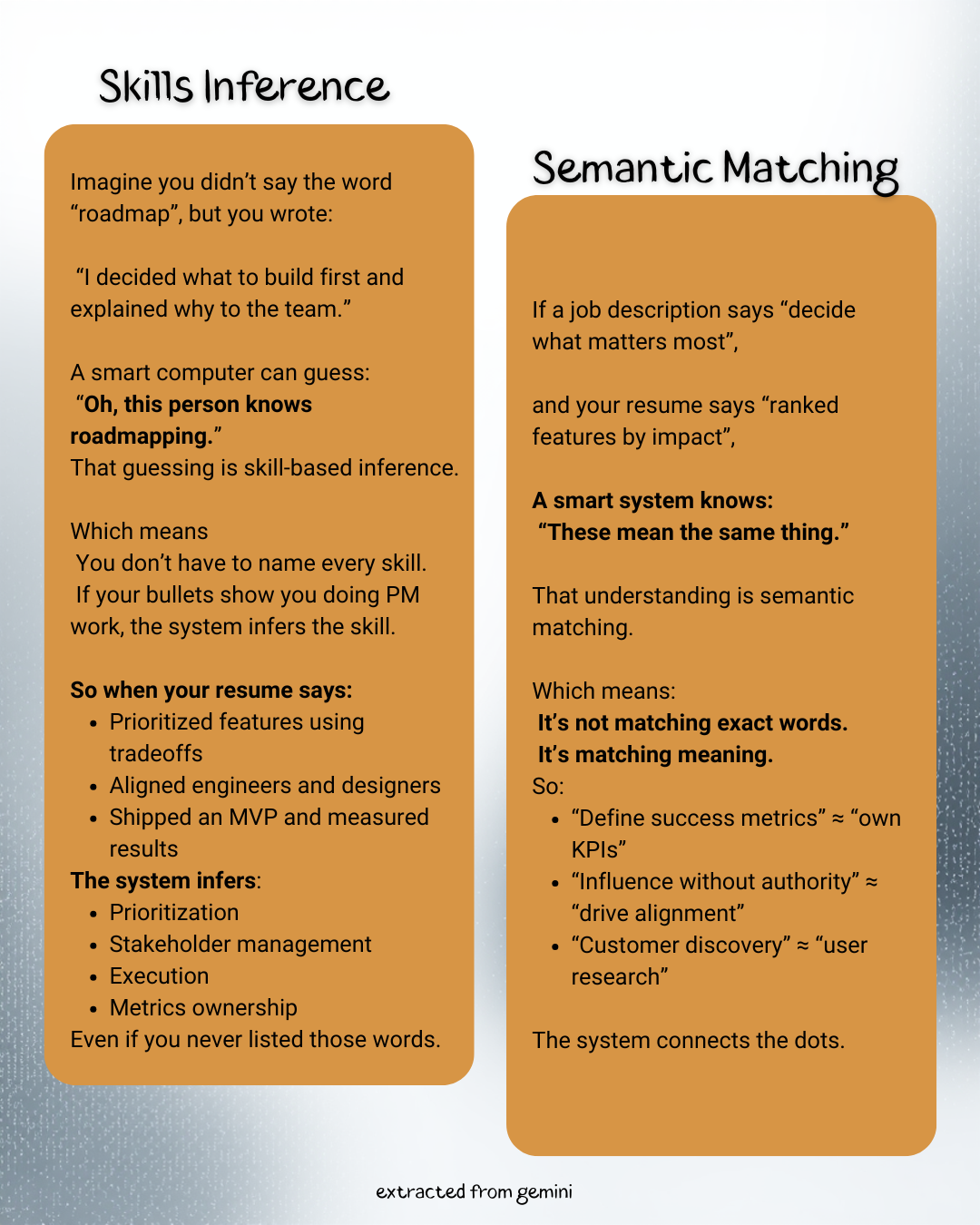
which explained a lot of why last year when I was job hunting my resume did not even pass ATS in many many instances until I kept updating it updating it and updated to a point where I guess I did pass the ATS but I’ve learned how there are companies now out there (one of the examples is Eightfold.ai) who have started building the back-end AI recruiting intelligence that builds on semantic matching.
Which is the topic of my newsletter today.
And also know that this newsletter is the first you are hearing about it because this is going to become more and more prevalent in hiring processes in all of 2026.
Our generation is living in the most exciting and anxiety inducing times in the history of job search.
Today I want to tackle the question of
- How do you get past the ATS (Applicant tracking system)?
- Is mass application a good strategy?
- The quality vs quantity?
- What is skill inference vs. semantic matching and how this has created the doom loop
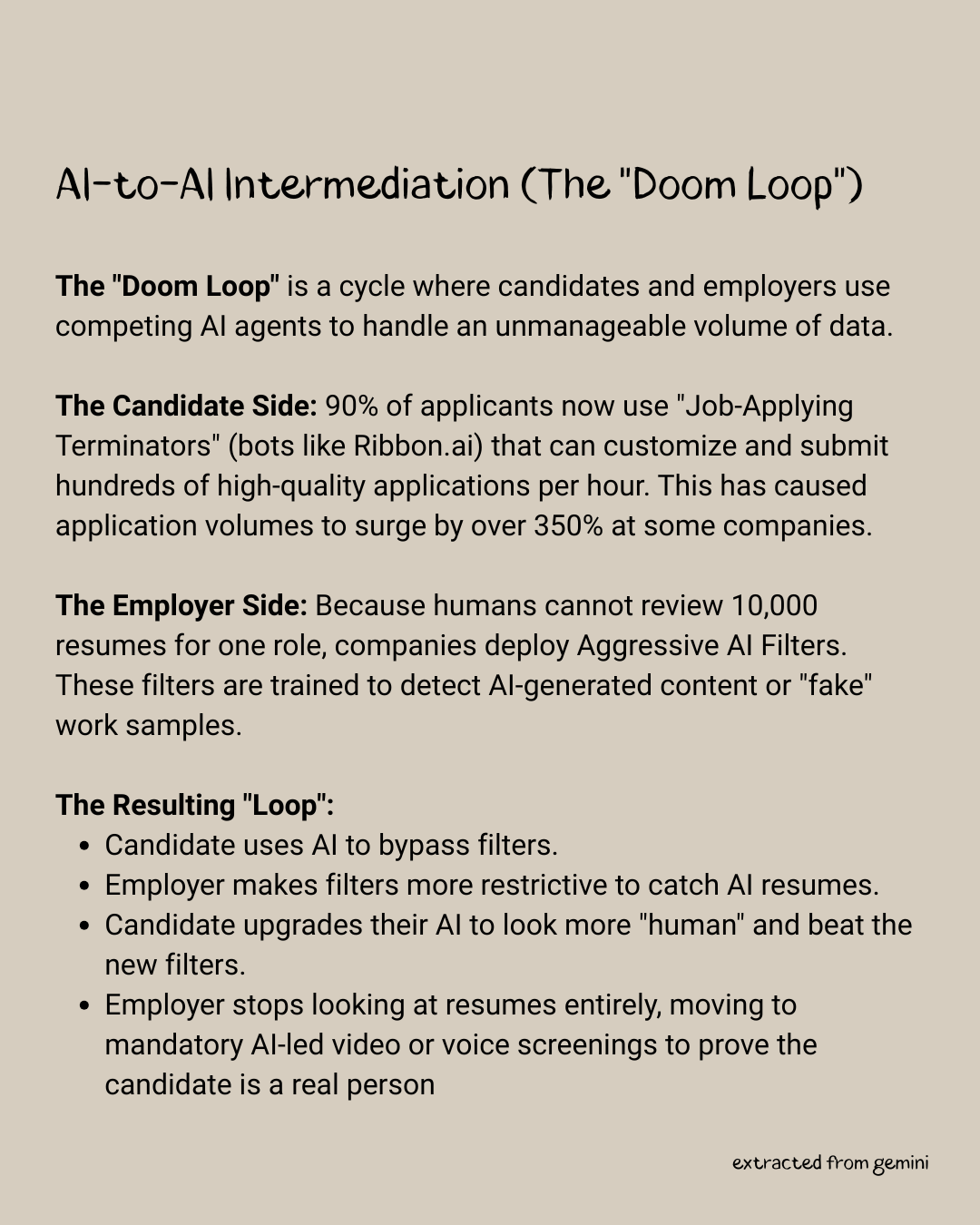
If you’re a Product Manager or any non-technical professional in tech, the job market has fundamentally changed and most candidates don’t realize they’re playing by outdated rules.
Here’s what’s actually happening: 79% of organizations have integrated AI into their hiring systems, up from 43% two years ago. But here’s the twist: while technical roles have adapted, non-technical professionals are often caught off-guard by how differently their applications are now being evaluated.
The keyword-stuffing era is over. Welcome to semantic matching.
🧠 From Keywords to “Skills DNA”: What Changed
Previously: Your resume needed the exact phrase “stakeholder management” to match a job posting asking for “stakeholder management.”
In 2026: Modern AI systems use semantic matching—they understand meaning, not just words. and this will become more front and center in 2026 hiring.
If you wrote “aligned cross-functional teams across engineering, design, and marketing to deliver product launches,” the system now infers you have stakeholder management, cross-functional leadership, and project coordination skills—even without those exact phrases.
A former teacher who “designed curriculum for 150+ students and presented to parent committees” can now match to a corporate training role because AI recognizes the underlying Skills DNA: instructional design, public speaking, and stakeholder communication.
In some ways I think this is good because You’re no longer competing on who stuffed the most keywords. You’re being evaluated on the substance of what you’ve actually done. The systems look for demonstrated impact, not buzzword bingo.
But If I played devil’s advocate
While semantic matching sounds fairer, there’s a darker reality: you have no idea what the AI is actually inferring from your resume. or what type “DNA” they are building of your Skills. You have no visibility.
When keyword matching ruled, the game was transparent. Job posting says “stakeholder management”? Put “stakeholder management” in your resume. You knew the rules.
Now? The AI might infer you have “strategic thinking” from one phrase, or it might not. You’re writing blind, hoping the black box interprets your experience the way you intended. There’s no feedback loop telling you what skills the system extracted or why you were rejected.
⚙️ What’s Really Screening Your Application
Your application goes through three stages:
Stage 1: Parsing & Normalization (Immediate)
The ATS extracts your employers, titles, skills, and education into structured data. Poor formatting kills your chances here before AI even evaluates you.
Stage 2: Semantic Matching (Automated)
AI models (using transformer-based technology similar to ChatGPT) analyze the semantic similarity between your experience and job requirements. This is where your “Skills DNA” gets evaluated.
Stage 3: Human Review (If you pass)
88% of companies acknowledge their automated systems reject qualified candidates—so most still have human review for top candidates. Your goal: get past Stage 2 so a real person sees your work.
🎯 If you were to rewrite some of Your PM Experience
Here’s how to write for semantic matching.
Each example follows Context → Action → Result:
Example 1: Feature Launch
❌ Keyword-Stuffed :
“Responsible for product roadmap and feature prioritization. Managed stakeholders and delivered features.”
✅ Semantic-Friendly :
“Defined Q3 product roadmap by analyzing user feedback from 2,000+ customers and competitive intelligence, prioritizing 8 features that reduced churn by 23%. Facilitated weekly sprint planning with 12-person engineering team and bi-weekly executive updates to align on trade-offs.”
What AI extracts: Product strategy, data-driven prioritization, stakeholder management, churn reduction, cross-functional leadership, communication skills, agile methodology
Example 2: Discovery & Research
❌ Keyword-Stuffed (Old Way):
“Conducted user research and customer interviews. Gathered requirements.”
✅ Semantic-Friendly (New Way):
“Led discovery for payment redesign by conducting 25 user interviews and analyzing 6 months of checkout funnel data (50K+ sessions). Identified 3 critical friction points causing 40% drop-off. Created journey maps and wireframes with design team, validated with A/B test reaching 15K users.”
What AI extracts: User research, qualitative analysis, quantitative analysis, problem identification, data interpretation, A/B testing, UX collaboration, hypothesis validation
The Pattern: Each bullet shows what was the situation (customer problem, business need, team size), what you specifically did (methods, tools, collaboration), and what changed (metrics, outcomes). Semantic matching AI recognizes this structure and extracts underlying skills automatically.
💼 What You Should Actually Do
1. Rewrite Your Top Achievements
Use the Context → Action → Result formula above. Instead of listing responsibilities, show what you accomplished and how.
Bad: “Managed product roadmap”
Good: “Prioritized 12-month roadmap based on analysis of customer requests (3,000+ tickets), revenue potential, and technical feasibility, resulting in 40% faster feature delivery”
2. Make Your Resume Machine-Readable
- Use standard headers: “Experience,” “Skills,” “Education”
- Avoid complex graphics, tables, or multi-column layouts
- Use simple, clean formatting with consistent fonts
- Save as .docx or PDF (not image-based PDFs)
- Test with free ATS checkers like Jobscan or Resume Worded
3. Build Your Digital Footprint
AI systems increasingly verify claims by checking:
- LinkedIn activity – Share insights, engage with content
- Portfolio or case studies – Show your work publicly
- Medium/Substack – Write about your craft
- GitHub – Even for PMs, share specs or frameworks
In 2026, your resume gets you screened. Your work gets you hired.
4. Emphasize Transferable Skills
Non-technical roles require demonstrating adaptability. Ensure your resume shows:
- Cross-functional collaboration – “Coordinated 8-person team across eng, design, data”
- Data-informed decisions – “Analyzed user behavior data from 10K+ sessions”
- Ambiguity navigation – “Launched MVP with 60% of planned features based on customer urgency”
- Technical communication – “Translated customer needs into technical requirements for API team”
These are the “Skills DNA” markers that semantic matching identifies—and exactly what hiring managers want.
- ⚠️ Avoid Keyword Stuffing
Don’t write: “Experienced in agile, scrum, kanban, jira, confluence, roadmapping, prioritization, stakeholder management...” AI can tell when you’re gaming the system. It looks for these skills demonstrated in context, not listed. - Avoid Vague Responsibilities
“Responsible for product strategy” tells AI nothing. “Developed 3-year product strategy based on TAM analysis ($50M opportunity) and customer interviews (40+ B2B buyers), securing $2M budget approval” shows what you actually did. - Don’t Ignore Metrics, your achievements have to be measurable.
Always quantify impact: team size, revenue, users, retention, time saved, efficiency gained. Numbers help AI understand scale and significance.
The era of keyword gaming is over. The era of demonstrating real impact has begun.
Now whether that’s good or bad, you tell me in comments?
How do you feel about this change?
That’s all for today!
—Nazuk
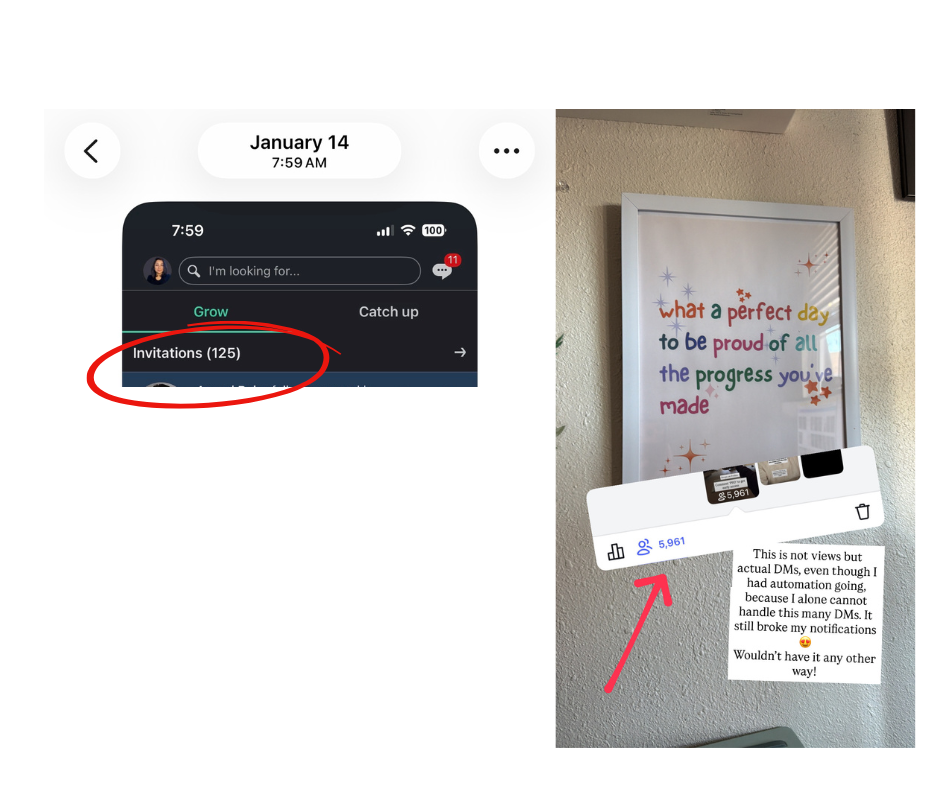
Ps. y’all broke my instagram and linkedin notifications 125 new connections in 12 hours with 1 post.
I am launching a dashboard with a system for folks to prepare for PM interviews with skills they already have.
MY GOAL IS HELP 200 OF YOU LAND A ROLE IN 2026.
So I will try and make is accessible for all.
Dashboard is a complete interview prep system that you need IF you don’t kwow where to start, have been failing interviews.
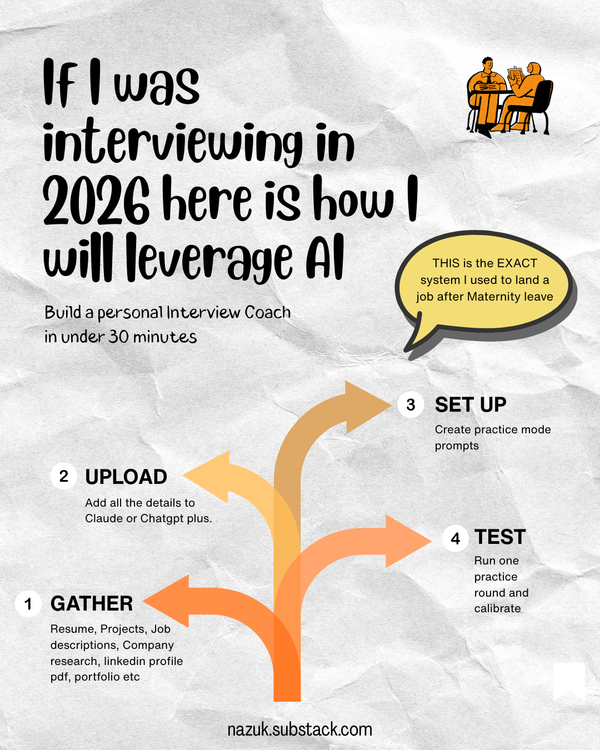
I have laid out an entire an entire system to prepare with AI and have AI act as your coach and give you feedback. Within 3 weeks you will be ready for your first interview.
The system is surprisingly simple and not a 10 module course that you will never finish. Comment ‘Dash’ on this newsletter and I’ll prioritize sending it you first.
Watch this ⬇️⬇️