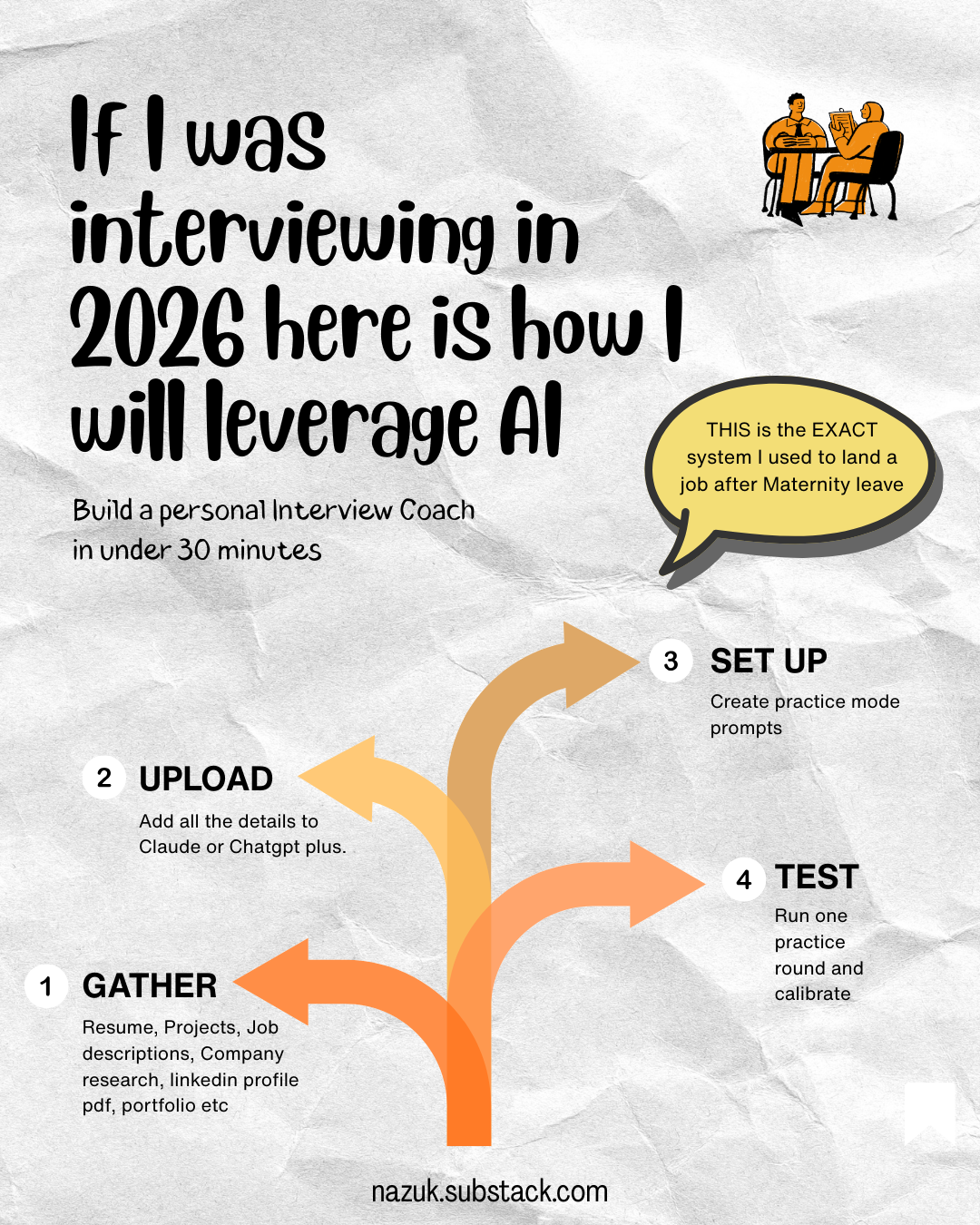
If I was interviewing in 2026 here is how I will leverage AI
This is the exact system I used to land a job in 2025 after maternity leave.
If you don’t know yet what a RAG model is… don’t worry, here is Gemini’s explanation for you
“RAG (Retrieval-Augmented Generation) is a method that makes AI models smarter by adding external knowledge at query time instead of relying only on what they were trained on.
Here’s how it works, step by step:
- Retrieve: When you ask a question, RAG searches a connected knowledge base (like PDFs, docs, or databases) to find the most relevant pieces of information using embeddings or vector search.
- Augment: The retrieved text is added to your original prompt — giving the model fresh, factual context.
- Generate: The model then writes a response using both the prompt and the retrieved info, producing more accurate, grounded answers.
In short:
RAG = Search + Summarize.
It lets ChatGPT “look things up” before answering, instead of guessing from memory.”
So when we build a RAG for interview prep… You are not going prompt by prompt to practice
The best part is that tools like ChatGPT and Claude already support this. You don’t need to code anything.
The problem with traditional interview prep
Most PM candidates still prep the same way they did in 2022. The system has changed. so much more competition now
They buy Cracking the PM Interview. They memorize CIRCLES and STAR. They do a few mock interviews with friends or pay $150 an hour for a coach. And then they hope the questions they practiced show up.
That approach breaks down in three ways.
- First, it’s generic. Those frameworks work for everyone, which means they differentiate no one. Interviewers have heard “stakeholder alignment” and “trade-offs” thousands of times.
- Second, it’s inefficient. You spend hours practicing questions you’ll never get asked, while ignoring the exact angles that matter for your background and your target companies.
- Third, it doesn’t scale. Human mock interviews are expensive, limited, and unavailable at the exact moment you’re actually studying, usually late at night, tired, and stressed.
Interviews in 2026 reward something very specific: your ability to connect your unique experience to a company’s real problems. Generic prep doesn’t help you do that.
This is where a personal RAG system changes the game.
Instead of an AI that vaguely knows product management, you get an AI that knows you.
It knows your resume.
It knows your projects.
It knows the companies you’re interviewing with.
It knows where you’re strong and where you struggle.
Think of it like an interview coach who has memorized your entire career and never forgets context.
And the best part is that tools like ChatGPT and Claude already support this. You don’t need to code anything.
Here’s how to build it in about 30 minutes.
What you’ll need:
You’ll need one AI tool with document upload (ChatGPT Plus or Claude both work), about half an hour, and your interview prep materials.
That’s it.
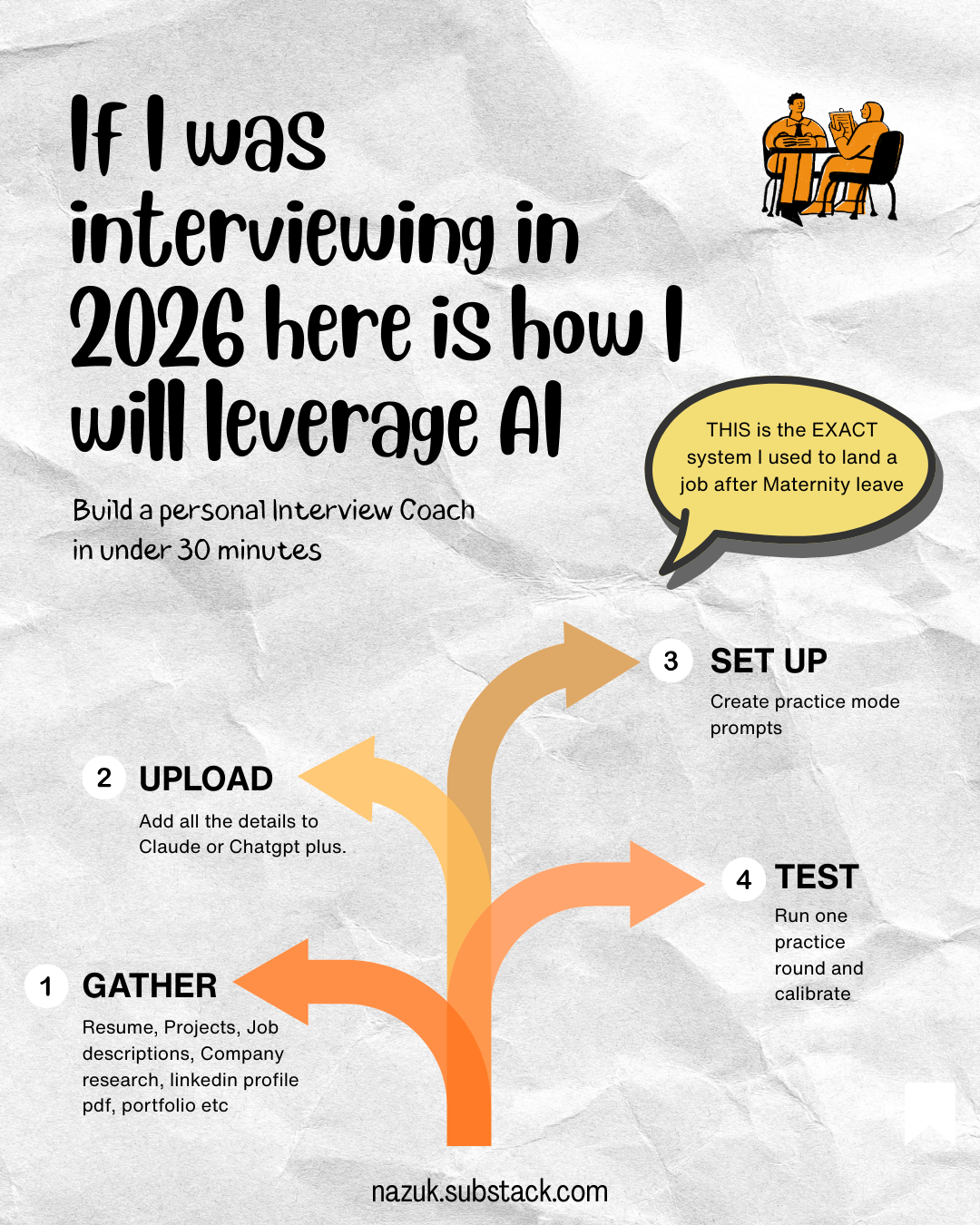
Step 1: Build your knowledge base
Create a folder with the following documents. Don’t overthink formatting. Rough notes are fine.
I have personally tested and used Google Drive with these documents and given access to that folder to refer to.
• Your resume and LinkedIn profile copied into a doc
• Descriptions of your top 5 projects, about 300 to 500 words each. Focus on context, decisions you made, trade-offs, and impact
• Job descriptions for the roles you’re targeting
• Company research: mission, recent launches, earnings call notes, known challenges
• A simple PM cheat sheet with the frameworks you like to use
• A short list of areas you struggle with, like metrics or executive communication
This is the raw material your AI will use to coach you. This is everything and has to be done right.
Step 2: Upload and index
Start a new conversation and upload all the documents at once. Then write something like:
“You are my personal PM interview coach. You have access to my background, target companies, and frameworks. First, summarize what you understand about my experience and goals.”
Read the summary carefully. If it missed something important, correct it. This step matters. You’re calibrating your coach.
Step 3: Create practice modes
This is where things get fun.
Save a few core prompts that you’ll reuse.
For behavioral questions:
“Generate three behavioral interview questions I’m likely to get at [Company], based specifically on my resume. For each question, tell me what the interviewer is actually trying to assess and which of my experiences fits best.”
For product sense:
“I’m interviewing for a PM role at [Company]. Give me a product design question that connects their current product strategy with my background. After I answer, critique my structure, depth, and how well I leveraged my experience.”
For execution and analytics:
“Create a realistic metrics or prioritization question relevant to [Company]’s business model. Make it something a PM there would actually face.”
These prompts become your daily workout.
Step 4: Test and tune
Run one question from each category. If it feels too easy, say so. If it’s not pulling enough from your background, tell it explicitly.
This is a conversation, not a one-shot query. The system gets better the more you interact with it.
Five powerful ways to use your system
- The daily question sprint
Spend 15 minutes a day. Ask for two random questions across different types. Answer out loud. Get feedback.
This builds reflexes. You’re training your brain to structure answers quickly, not perfectly.
- Company-specific deep dives
When you’re serious about a company, ask:
“Create a full interview simulation for [Company]. One behavioral, one product sense, one execution question, all tailored to my background. After each answer, tell me exactly what I should improve.”
You’re essentially running a private, realistic mock interview without paying anyone.
- Weakness targeting
If you know metrics trip you up, lean into it.
“I struggle with metrics questions. Generate five progressively harder problems relevant to fintech products. Show me the ideal answer structure after each attempt.”
This is where AI shines. Infinite patience, infinite variations.
- Story bank building
One-time exercise, huge payoff.
“Based on my projects, help me build 8 to 10 strong stories that cover leadership, conflict, failure, ambiguity, and impact. Tell me which companies and roles each story fits best.”
Now you’re not scrambling mid-interview trying to remember an example.
- Full mock interview mode
When you want to go deep:
“Run a full mock interview for a PM role at [Company]. Ask me 4 to 5 questions with realistic follow-ups. Be tough. At the end, score me and tell me what to fix.”
This is gold before the final rounds.
Power user techniques
Reverse-engineer the job description, paste the JD and ask:
“What signals are they really hiring for? What questions map to each signal? Which of my experiences should I emphasize?”
You’re decoding the interview instead of guessing.
The night-before cram session
“Based on my background and this company, what are the five most likely questions I’ll get tomorrow? Give me a 60-second outline for each.”
You walk in calm, not scrambling.
Post-interview debrief
After every real interview, write down what you were asked and how you answered. Upload it.
Then ask:
“What did I do well? What should I have said differently? Update my coaching guidance.”
Your system compounds with every interview.
A real, relatable example
Imagine you’re interviewing at Visa and you have a background in payments and fintech.
Prompt:
“Give me a product sense question for Visa that connects to my experience building card-based payment products.”
You might get:
“Visa notices that small businesses in emerging markets are adopting digital payments but struggling with chargebacks and reconciliation. As a PM on Visa Direct, how would you investigate the problem and what would you build?”
This isn’t a generic ‘design a payments app’ question. It’s realistic, role-specific, and forces you to use what you already know.
After your answer, the feedback might point out that you nailed ecosystem thinking but missed regulatory considerations or network incentives.
That’s the level you want to practice at.
Common mistakes I learnt hard way
First, don’t treat AI like Google. If you don’t give it context, you’ll get generic output. Feed it well.
Second, speak your answers out loud. Interviews are verbal. Use AI for questions and feedback, not silent typing.
Third, don’t outsource thinking. AI helps you sharpen your reasoning, not replace it. Your opinions still matter.
Finally, still do one or two human mocks if you can. AI gives you volume and personalization. Humans help with presence and energy.
What to do next
This weekend, spend 30 minutes building your system. Done beats perfect.
If you’re still preparing the way you did in 2015, you’re leaving a huge advantage on the table.
Your future hiring manager doesn’t want a perfect framework reciter. They want someone who understands their problems and can think clearly under pressure.
This system helps you become that person.
See you next week on Friday.
-Nazuk
A lot of this newsletter was dictated via Wispr Flow. edited manually.
P.s If this newsletter gets 10 comments, I will record a YouTube video, and a step-by-step with all the resources I created for myself. :)