From Chatting with AI to Building Workflows
[Video Included] You Don’t Need to Prompt Better. You Need to Think in Workflows.
Last week, I missed sending out the newsletter, actually honestly just forgot. LIVE classes have kept me busy between shooting, writing social content and building the course, and being a mum to an almost 1-year-old, life is busy, good busy anyway.
So far, we have 42 founding members who purchased the early version of the course and have joined the live classes.
Check out student testimonials here and become a founding member.
Initially, I planned on a self-paced course, but TBH, I enjoyed teaching LIVE. In this new AI-driven Era, I think in-person interactions will become more and more needed.
So if you have been using AI and not quite getting the results you desire. This course might be for you. I focus on 2 things in this course - (all things) Brainstorm with AI and Write with AI, which are 2 major functions if you are a busy PM, operator, or marketer.
Today’s Deep Dive
Most folks I talk to use ChatGPT like Google on steroids. Type a smarter prompt. Get a better answer. Move on.
But here’s the twist:
If you’re only chatting with AI, you’re leaving 80% of its power untapped.
Most people are stuck in what I call the “Chat Trap.”
They treat AI like a genius intern, helpful in bursts, but not integrated into how they work.
The future doesn’t belong to better prompt writers. It belongs to those who learn how to build systems with AI.
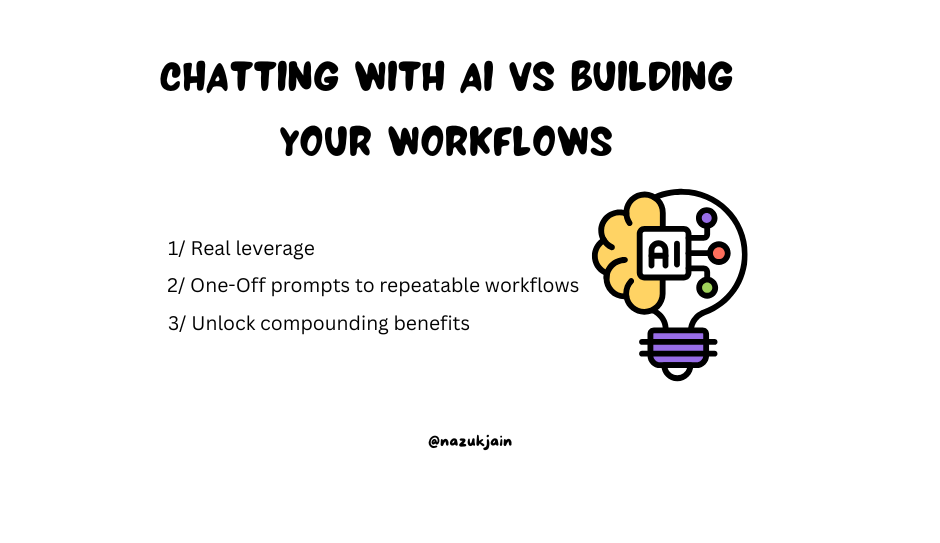
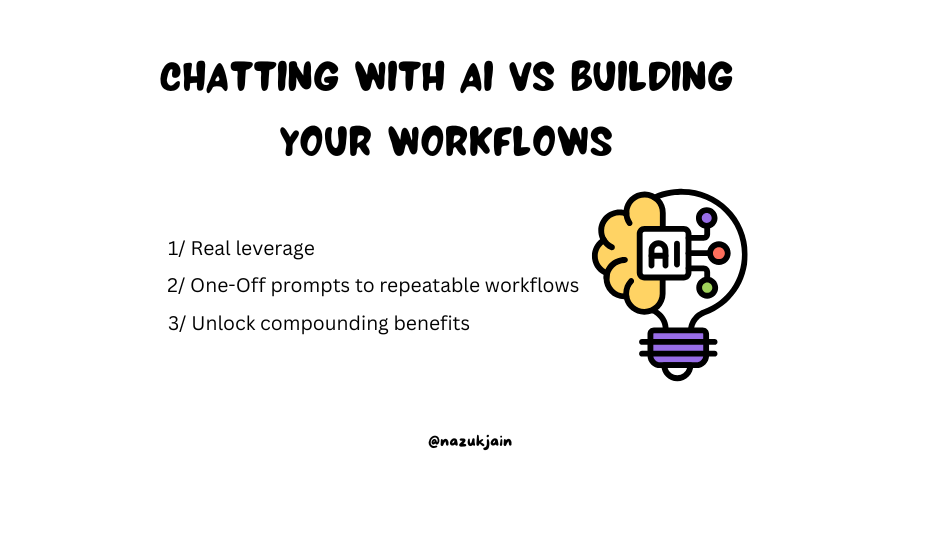
From “One-Off Prompts” to Repeatable Workflows
Let’s say you’re a product manager writing release notes for a new feature. Most people jump into ChatGPT and type:
“Write release notes for a new budget tracking feature.”
It gives you something decent. Maybe even publishable.
But next week, when another feature goes live, you're back at square one, prompting from scratch.
That’s a chat.
Now imagine this instead—a reusable workflow:
- Step 1: You paste your Jira ticket or product spec
→ AI pulls the key update, benefit, and user impact - Step 2: You upload past releases for style reference
→ AI matches your voice and structure - Step 3: You select the audience (users, internal team, or execs)
→ AI adjusts tone and format accordingly - Step 4: You generate multiple drafts in seconds for exteranl and internal audience
→ Final edit is 10%, not 90%
You’ve gone from writing one release note to building a machine that helps you publish every release note faster, clearer, and more consistently.
A chat answers a question, solving a one-time task.
A workflow upgrades how you think, decide, and ship, building a repeatable system.
And that’s how you shift from using AI occasionally to making it a core part of how you ship. Same task. Totally different level of leverage.
Why the “Chat Trap” Feels So Tempting
For decades, we’ve been trained by search engines. Ask, receive, ask more, receive more. But that mental model ask → answer is inherently short-term.
When you rely on chats:
- You treat AI like a vending machine
- You repeat work instead of refining it
- You think in outputs, not systems
Building workflows, however, shifts your mindset from transactional to transformational.
It's like the difference between hiring a freelancer for one task
vs. designing a team process that runs with or without you.
Workflows Unlock Compounding Benefits
Let’s borrow from economics for a second. In finance, compound interest beats simple savings. $100 saved repeatedly outperforms one $1,000 deposit.
AI workflows work the same way.
Every time you:
- Reuse a structured prompt sequence
- Save a template
- Automate an AI action based on your behavior
This is building compound leverage.
Suddenly, you’re not just saving time. You’re upgrading your thinking environment.
You reduce decision fatigue.
You get more consistent results.
You increase your creative confidence.
And the best part? It scales.
Go from chatting with AI to building a repeatable, scalable workflow.
Most folks start here: (which is okay to get started with AI), but this is as generic as it gets.
“Write a viral LinkedIn post about product strategy.”
You might get a workable draft. You edit. You post.
Next week, you start from scratch again.
If you were to build a workflow → you would take micro steps in a journey into mini tasks working with AI and stitch them together.
- Input: This week’s theme (e.g., “decision-making under pressure”)
- Input: A detailed voice memo about something you learned, a personal anecdote…
- Step 1: AI extracts a hook, story, and takeaway
- Step 2: You choose tone and structure (bold, human, insightful)
- Step 3: Post is generated, image is suggested, hashtags are added
You’ve turned insight into content in minutes.
But more than that, you’ve created a system that:
- Starts from your voice
- Keeps your message consistent
- Reduces cognitive load
You’re not just writing faster. You’re thinking more clearly and building a repeatable flywheel.
Watch this video where I show you how to build a workflow live in action.
AI isn’t here just to answer your questions. It’s here to amplify how you work.
But only if you treat it as a collaborator not a vending machine.
So here are a few questions to sit with:
- What’s one repeated task in your week you could turn into a workflow?
- Where are you still treating AI like a tool for answers instead of a partner for systems?
- If you disappeared for 2 weeks, would your AI setup keep working for you or fall apart?
Building workflows doesn’t require you to be an engineer. It requires you to be a systems thinker.
That’s how you move from “smart use” to sustainable scale.
Want to start designing your first AI workflow?
Pick one task you repeat often: reporting, writing, synthesizing, or planning.
Ask:
- What’s the input I always start with?
- What’s the format or structure I always need?
- What’s the decision I need help making?
Then use that as your template.
Refine it weekly. Save it. Improve it.
And stop starting from scratch.
Because the future of AI isn’t just about asking better questions.
It’s about building better engines.
That’s a wrap for today.
-Nazuk
Like | Share | Comment below if you learnt something new.
🛠 Ready to escape the Chat Trap? Start here → I am building a “Become an AI-powered PM” self-paced course. You can become a founding member of the course with early bird pricing.
Read what founding members have said about the course