Day 4: Flip interview bias in your favor with AI
Can You Turn Interview Psychology in Your Favor?
Tech Interviews aren't fair, and PM interviews are even less so. In engineering interviews, at least there is something binary: either your program worked or it didn’t.
PM interviews I wish were more objective, while companies do try hard, and there are full-blown departments (in big techs) to address this, but this is a tough problem to solve: remove human bias from the interview process entirely.
Google has a structured interview style, which they say “minimizes” human bias.
But here's the twist: once you understand how these biases work, you can use them strategically.
Today’s newsletter contains 5 prompts to practice “turning biases in your favor with instructions.
Reaserch confirms this too!
Research consistently shows that hiring decisions are far from objective:
- First impressions form in 7 seconds and influence the entire interview (Princeton University study on thin-slice judgments)
- Similarity bias makes interviewers 2.6x more likely to hire candidates who remind them of themselves (Harvard Business Review analysis)
- The halo effect causes one positive trait to overshadow everything else, with 73% of interviewers admitting to being swayed by a single impressive quality (Journal of Applied Psychology research)
- Recency bias means candidates are 40% more likely to be remembered positively if they end strong (University of Michigan memory studies)
The question isn't whether bias exists; it's whether you'll let it work against you or for you.
The Most Common are these 5 Biases That Shape Every Interview
1. Anchoring Bias: First Impressions Stick
Your interviewer's brain latches onto the first significant piece of information you share. Everything that follows gets measured against that initial anchor.
How to use it: Lead with your biggest win in "Tell me about yourself." Don't bury your best achievement—make it the foundation that colors everything else.
But I’ll caution that if you anchor too high, that’s what you will get judged against. Key is ‘balance’ at YOUR experience level.
2. Recency Bias: Last Words Linger
Humans remember endings disproportionately well. Your final impression carries outsized weight in their decision-making process.
How to use it: End every interview with a sharp insight or compelling story. When they ask "Do you have questions?" don't just ask about benefits—share a thoughtful observation about their business.
3. Halo Effect: One Strength Overshadows All
When interviewers spot one exceptional quality, it creates a positive glow that makes them overlook weaknesses and amplify other strengths.
How to use it: Identify your superpower and weave it throughout the conversation. If you're a natural leader, find ways to demonstrate leadership in multiple answers so it becomes your defining characteristic.
Caution: the “superpower” that you highlight in the interview should be what the interviewer is looking for; otherwise, it’s a mismatch. Choose wisely.
4. Similarity Bias: We Hire People Like Us
Interviewers unconsciously favor candidates who mirror their communication style, values, and experiences. It's not about being fake—it's about finding genuine connection points.
How to use it: Listen for their language patterns and core values. If they emphasize being "data-driven" or "customer-first," naturally incorporate that language into your responses when authentic.
5. Contrast Effect: You're Judged Against Others
Your performance isn't evaluated in isolation—it's compared to other candidates they've recently interviewed.
How to use it: Differentiate yourself with unique frameworks or perspectives. Don't just answer questions; provide distinctive insights that make you memorable against the backdrop of similar candidates.
Instead of fighting human nature, work with it.
Before the interview: Prepare your anchor story, your most impressive, relevant achievement that sets a high bar for everything that follows.
During the interview, Listen for opportunities to mirror their values and language authentically. Identify which of your strengths is resonating most and amplify it throughout the conversation.
At the end: Craft a memorable closing that demonstrates your strategic thinking about their challenges or opportunities.
Remember: You're not manipulating, you're communicating more effectively by understanding how your audience naturally processes information.
Practice with AI
1/The Anchoring Interviewer
"Act as my job interviewer with strong anchoring bias - whatever I say first about myself will heavily influence how you judge everything else. Ask me to 'tell you about myself' and respond based on how my opening shapes your perception. Challenge me if I don't anchor strongly enough."
2/ The Recency-Focused Interviewer
"Act as my interviewer with recency bias - you remember my last words most clearly. Conduct a standard interview but let your final impression be disproportionately influenced by how I end and answer 'Do you have questions?' Give me feedback on my closing impact."
3/ The Halo Effect Interviewer
"Act as my interviewer prone to the halo effect. Once you identify one standout quality in my responses, let it overshadow any weaknesses. Tell me which trait created the halo and how it affected your perception throughout the interview."
4/The Similarity-Seeking Interviewer
"Act as my interviewer who favors similar candidates. Create a background for yourself, then interview me showing clear preference when I mirror your language or demonstrate aligned values. Give feedback on connection opportunities I missed."
5/The Comparison Interviewer
"Act as my interviewer, affected by contrast bias. Tell me if the previous candidate was strong or weak, then interview me while constantly comparing my answers to that person. Help me understand how I'm being measured against this invisible standard."
Bias (for good or for bad) is hardwired into human decision-making.
The candidates who succeed may not always be the brightest and most skilled, but those who understand it and adapt accordingly.
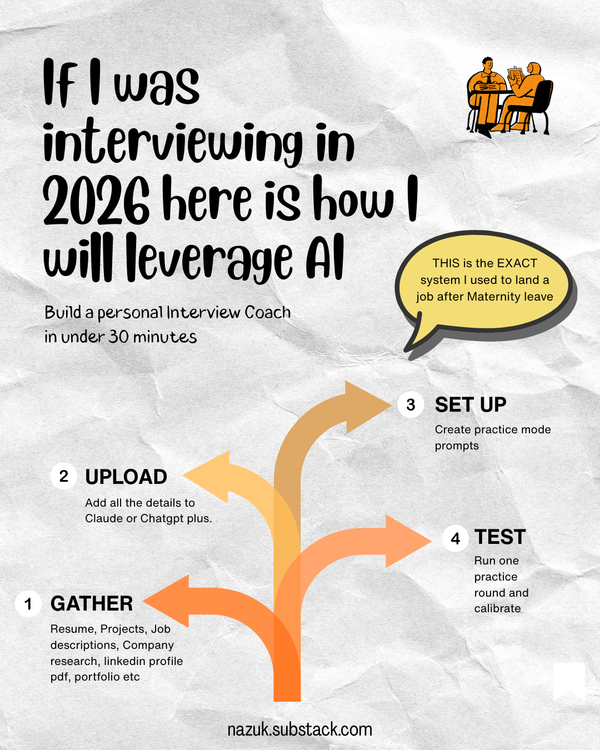
PROMPT INSTRUCTIONS:
1. Set Up Your AI Coach
- Copy the entire prompt (whicever one you want to pratice) and paste it into ChatGPT, Claude, or your preferred AI
- Let the AI create the interviewer persona and start the mock interview
- Respond as you would in a real interview
2. Practice With Purpose
- Stay in character - treat it like a real interview
- Apply the bias strategy from the newsletter while answering
- Don't break character until the interview ends
3. Get Feedback
After the mock interview, ask your AI coach:
- "How well did I leverage the [specific bias]?"
- "What could I have done better?"
- "Rate my performance and give specific improvement tips"
4. Iterate and Improve
- Run the same prompt 2-3 times with different answers
- Mix and match - try different prompts for the same job scenario
- Track your progress - notice which biases you handle best/worst
Caution:
✅ do these:
Practice with real job descriptions and tailor your responses
Record yourself (audio) to catch filler words and pace
Practice each prompt at least twice before moving on
❌ Avoid this:
Rushing through without applying the bias strategies
Practicing only the biases you're already good with
Skipping the feedback step
Made it till last!
Thank you!
This is a new 7-day series on Interview prep where every day I will share the techniques that I have crafted and perfected over the years.
These will be short reads.
Like or comment if you find it useful!