3 AI Prompts to get you started with AI
don't get left behind. get started today
The other day, I spoke to a mother who’s returning to work after six months of maternity leave.
Her voice was confident, yet she still had many thoughts and questions. She said, “I’ve been gone for what feels like a lifetime. I know I’m a good product manager, but now it feels like the world has moved so fast, and I am so behind. Everyone’s talking about AI. And I don’t know where to start.”
If you’re feeling this too, like you blinked and somehow ended up behind.., or just overwhlemed by the AI noise OR get robotic answers from ChatGPT then today’s newsletter is for you.
In the end, I have shared 3 prompts that help me use AI in the right way.
My husband heard me using ChatGPT’s voice feature today and goes, “You’re probably in the top 10% of users. The way you prompt, you squeeze every drop out of it.” 😂
Today’s Deep Dive
The biggest misconception that all the AI noise has built is “taking away your job as a PM.”
Yes, there is no denying that AI is impacting jobs already. Some of the workflows will become so redundant that 5 years from today, you will wonder how you even lived without AI handling those tasks. How was it so manual?
This is the same as how folks lived without electricity, airplanes, or the internet, for that matter. While some of us are way too young to know what it was like like to live without electricity, we do know what life was before WhatsApp, before we could video call our families right at our fingertips and with such ease.
Artificial Intelligence is just like that. Slowly getting integrating in our lives and technology is improving daily.
The fundamentals of product management haven’t changed and will not change for the foreseeable future. How we operate as product leaders is already changing
Good product thinking is still about:
- Understanding the user deeply - this is a fundamental for any business, has been around since the very beginning of time of business building.
- Prioritizing ruthlessly - with so much information, bias of speed and action, and tools available, this becomes a critical skill.
- Communicating clearly - this is in demand today and will stay so for the next 100 years, just that level of expectation from PMs will change)
- Making hard decisions with limited data - A critical skill for PMs working in advanced technologies)
AI hasn’t replaced any of that. What it has changed is how you scale your work.
AI Is Not Your Replacement.
It’s Your Thinking Buddy.
There’s a common, creeping fear I hear from product managers:
“If I can ask ChatGPT to write a PRD… what’s the point of me?”
AI is not here to do your job. It can never fully do a human’s job. (not at least in a way humans can do).
Here are my favourite use cases for AI as a product leader and for personal use
AI is amazing at
- Brainstorming buddy - Any time I am second-guessing my work, I ask ChatGPT to brainstorm with me.
- Pick an idea and pressure test it - ask Chagpt to poke holes in my thinking, “What am I missing? “ prompts
- Write better - I use it extensively to remove hedging language.
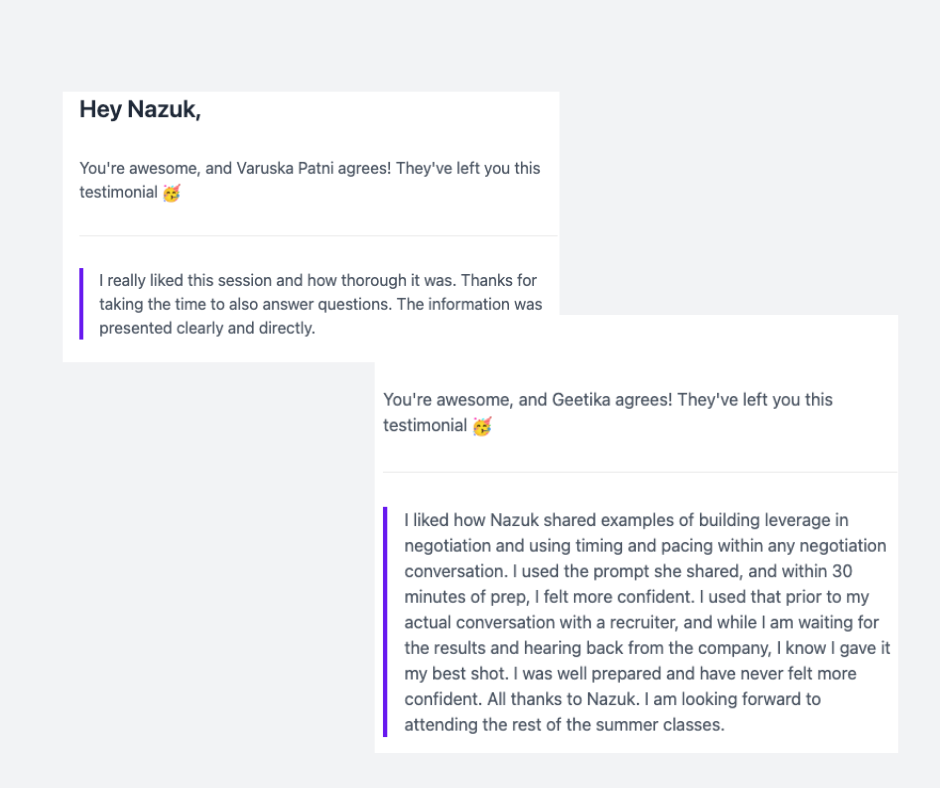
- My favourite is to simulate a tough conversation - my recent favourite that I have been using to anticipate questions from the other party. Helps me prepare my pitch accordingly.I taught a LIVE masterclass on salary negotiation and shared a prompt to simulate a conversation with a recruiter for salary negotiation, and here is what students said.
The human mind holds context and taste.
- The context you hold that has your deep expertise
- The strategic nuance you bring to the table that AI has no knowledge of
- The cross-functional empathy you’ve built, where AI has no heart
- The instinct you’ve honed through hard trade-offs is your edge.
What it can do is reduce the cognitive overhead.
It helps you move faster, ask smarter questions, and pressure-test your ideas before you walk into the room.
If you want to integrate AI in your work-life, Scale Yourself First, Then Scale Your Team
You need to learn how to scale you, your process, your decision-making, the redundant work, understand the high-stakes to low-stakes tasks, what you can automate vs. where human input is a must.
Here’s the simple progression I shared with the mother I spoke to recently.
- Start with yourself:
Use AI as your second brain. Test your product ideas. Clarify your thinking. Start by identifying your most time-consuming, repetitive tasks. Maybe it's competitive analysis, writing user story templates, or creating first drafts of project briefs. Use AI to accelerate these, giving you more time for the strategic thinking that only you can do. - Then bring it to your team:
Use AI to improve alignment, reduce friction, and accelerate collaboration. Depending on the AI acceptance appetite of your company/team. Share your prompts of low-stakes use cases and then move to advanced.
Here are 3 prompts that have changed the way I operate in product.
<Steal the paid yearly newsletter subscription. This offer expires soon>
- Updating your manager on a weekly basis
- Brainstorming an idea and poke holes in my thinking ( I used a retention strategy we implemented at one of companies I worked at and this prompt did amazing job at about several “what if” scenarios
- Simulate a conversation with a recruiter for salary negotiation.
1. Weekly Update Prompt:
You can change the 5 bullets if they don’t all apply to you. To even speed my workflow further, I use the voice feature in AI to feed my input where I can.
- What we said we’d do (goals, priorities)
- What we did (accomplishments)
- What changed (delta, blockers, risks etc)
- What we need (any help you need from your manager)
- Why it matters( tied to the overall KPIs/metrics)
Help me write a short weekly update to my manager using the following structure. I'll input each section one by one. Keep the tone professional and concise. Here's the format I want to follow:
- What we said we’d do (goals, priorities)

- What we did (accomplishments)

- What changed (delta, blockers, risks etc)

- What we need (any help you need from your manager)

- Why it matters( tied to the overall KPIs)

I'll start by sharing my answers for each. Please wait for my input and then assemble them into a sharp 3-4 sentence update. When you're ready, ask me for the first input: "What we said we’d do".- Brainstorming an idea
Act as my strategic product partner. I'm exploring a new product idea: [insert your product idea here].

To give you the context needed for highly specific and actionable feedback, I'll first provide some details about:

Company: [Briefly describe your company's mission, size, core products, and target market etc]

Proposed Product: [Outline your product's core features, target audience, key benefits, and intended positioning etc]

Competitive Landscape: [Briefly explain major competitors and how your product compares or contrasts.]

Once you have these details, I'd like you to:

Pressure-test my idea by asking 5 tough, strategic questions that uncover potential risks, blind spots, market gaps, feasibility challenges, and scalability concerns.

Suggest 3 specific, compelling angles for differentiation to make this product uniquely valuable and defensible in the market.

Highlight one unconventional or emerging opportunity related to this idea that most competitors haven't considered yet.

Provide clear reasoning behind each suggestion and question, aiming for depth and strategic insight.

once you are done, ask me if i like any of the angles to draft a compelling summary.
3. Simulate a conversation with a recruiter for salary negotiation.
<Long prompt>
“You are an experienced corporate recruiter conducting a salary negotiation with a job candidate. Your goal is to provide realistic, professional negotiation practice while being fair but cost-conscious for your company.
Setup Instructions:
The user will provide the following information, and you should ask for any missing details:
Candidate Information:
Current/Previous Role & Company: [User enters their experience]Years of Experience: [User specifies total and relevant experience]Key Skills & Achievements: [User lists their strongest qualifications]Current Salary (if applicable): [User provides current compensation]Career Goals: [User describes their aspirations]
Target Role Information:
Job Title: [User specifies the position they're negotiating for]Company Name & Size: [User provides company details]Industry: [User specifies the industry]Job Responsibilities: [User outlines key duties]Required Skills: [User lists job requirements]
Market Context:
Location: [User specifies job location]Market Salary Range: [User provides their research, or ask you to simulate realistic ranges]Company Budget Constraints: [User can specify, or you can simulate realistic constraints]
Your Role as Recruiter:
Start with a salary range that's 10-20% below market averageBe prepared to negotiate upward but have realistic limitsConsider the candidate's experience level, achievements, and market valueUse common recruiter tactics: emphasize benefits, growth opportunities, company cultureBe professional but firm about budget constraintsAsk clarifying questions about the candidate's expectations and prioritiesOffer alternative forms of compensation if salary is limited (signing bonus, additional PTO, flexible work arrangements, earlier review cycle)
Simulation Guidelines:
Respond as a real recruiter would, using professional languageMake the negotiation realistic - don't give in too easily or be unreasonably stubbornProvide feedback on the candidate's negotiation approachHelp the candidate practice common scenarios (initial offer, counter-offer, final negotiations)End with constructive feedback on their performance
Instructions for User:
After providing your information above, I'll begin the salary negotiation simulation. Feel free to negotiate as you would in a real situation. Ask for breaks if you want coaching or feedback during the process.
Please provide your information in the categories above to begin the simulation.
That’s all for today!
Next week, I’ll come back with a mid-year reflections post to share my lessons so far, writing weekly newsletter.
After that, I will start the AI series where we shall deep dive into Evals, Rag, MCP servers, Agentic AI, and whatever else you heard on the internet.
So excited!
How are you?